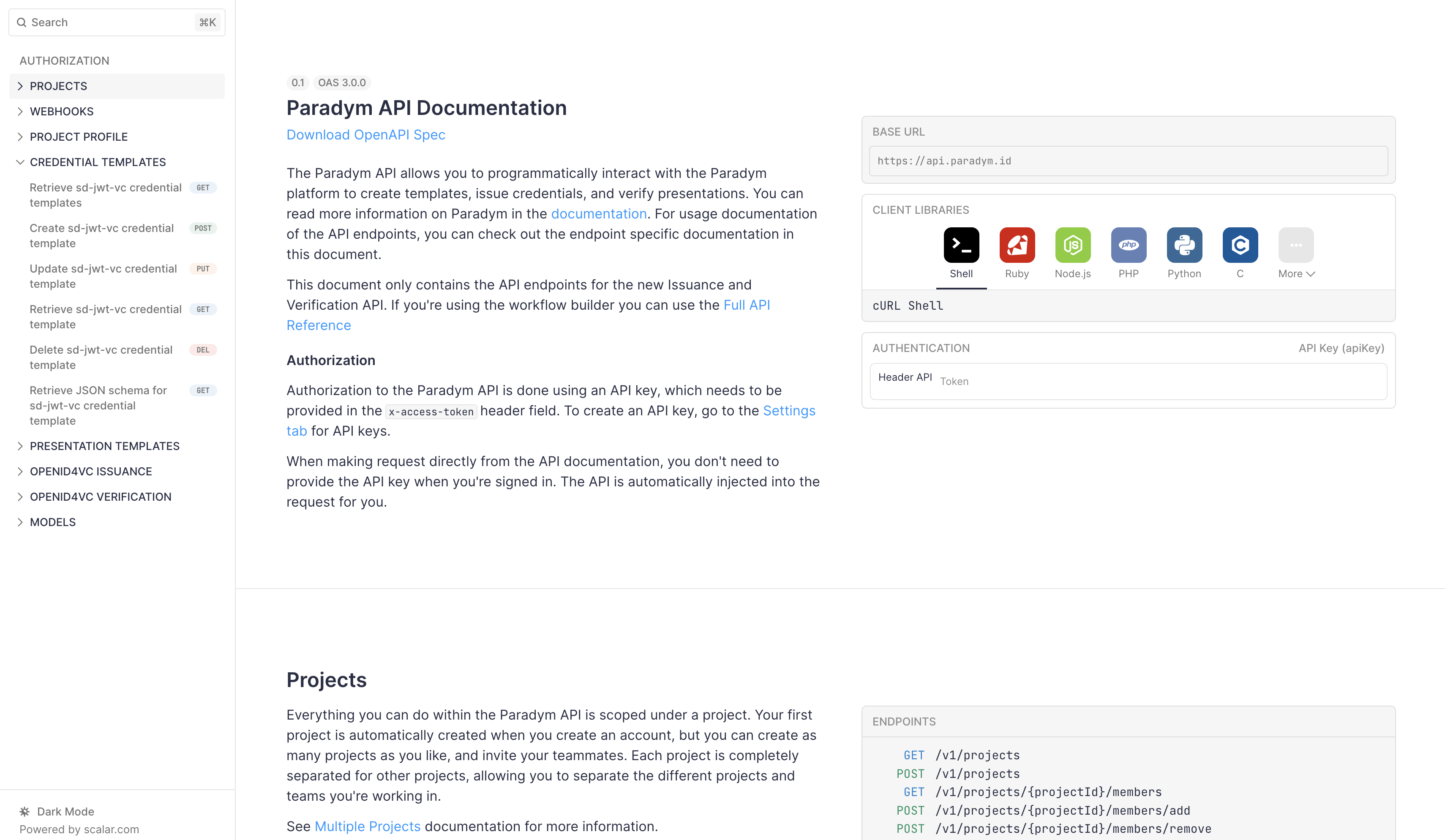
Interacting with the API
Paradym is an API-first platform, that means (almost) everything that you can do in the dashboard, you can do through the API.
The Paradym API is hosted on https://api.paradym.id .
Projects in Paradym are now called wallets, and the canonical API endpoints live under /v1/wallets/**. The previous /v1/projects/** endpoints are deprecated and frozen: they keep working for existing integrations (with their project-named request and response fields) and their responses carry a Deprecation: true header, but they will not receive new features — use /v1/wallets/** for new integrations.
If you’re working in JavaScript or TypeScript, make sure to check out our Paradym TypeScript SDK
Example using cURL
An example of retrieving all your wallets using cURL looks as follows:
curl 'https://api.paradym.id/v1/wallets' \
--header 'x-access-token: paradym_xxxxxxxx' \
--header 'Content-Type: application/json'
Wallet Scope
Most of the API endpoints are scoped under a wallet, and for these endpoints a walletId needs to be provided in the URL. You can find this id in the Settings tab on the Paradym dashboard, or on the overview page . Read more on wallets.
Authorization
Authorization to the Paradym API is done using an API key, which needs to be provided in the x-access-token header field. Follow the Quickstart guide to create an API Key.
An API key is scoped to a user, and thus has full access to all wallets that the user that created the API key has access to.
Error handling
When a request fails, the Paradym API responds with the relevant HTTP status code and a structured error body that includes a numeric error code. See Error Codes for the full overview and the meaning of each code.
API Reference
The API Reference lists all endpoints that are exposed by the Paradym API, including expected request and response types, example values, and usage documentation. In addition, the API reference allows you to make make requets to our API right from the UI. This is useful when you’re just getting started, or want to try out some new things.
When you’re signed in, an API key for interacting with the Paradym API does not have to be provided within the API reference, making it even easier to get started with the API.